Saturday, March 21, 2015

Using a Textbook / Building a Community

"Is covering the material the same as understanding it?" Ask Daniels and Zimmerman in Subjects Matter (189). As I know from personal experience, the answer to this question is no. Just because you read something, that does not mean that you understand it or will remember it. In Chapter 6, Daniels and Zimmerman deliver a few great strategies to maximize textbook learning. I really liked Jim Burke's "meet your textbook" sheet, especially the inquiry about reading speed. Especially with middle schoolers, it can be hard to manage homework time. By becoming aware of your own reading pace, it will be much easier for you to tackle your assigned reading. I also appreciate that "reading" speed really means reading and taking notes, emphasizing the importance of active reading. I also think that the SQ3R method would be very helpful for students, but I can totally see why they caution teachers not to let SQ3R be the be-all-end-all in reading strategies- it has the propensity to become rote.

With all the strategies in this chapter, Daniels and Zimmerman have made it clear that it is important to scaffold these activities with each student. Every teacher success story in this book reports that the teacher took the time in the beginning of the year to explicitly model exactly how to participate and use each strategy. Especially with the types of on-going projects that are in these 2 chapters, it is crucial that students know what is expected of them and that there is accountability between students. Otherwise the activity wouldn't work at all.

They also emphasize how each of these activities could be given a social dimension- this is a big plus for middle level learners as they are going to try to be talking to each other anyways.

I have 2 questions, however, regarding the content from these 2 chapters. One is about taking risks. While Daniels and Zimmerman offer a few opportunities for evidence of "risk taking," I still wonder what that actually means and how can you see it? What's a risk and what's a guess? What makes a risk safe? Daniels and Zimmerman say that modeling your passion for your subject, valuing students opinions, and holding brief in class conferences with individuals helps "make the classroom a place where students trust the teacher and believe that it's safe to take risks, a place where it's OK to ask questions when they don't understand something, and they can expect to receive the support they need to handle challenges" (206). That all sounds great, but I'm still working out what that all means, what it actually looks like, and how you that you've achieved that.

My other questions is more basic, but, how many multi-day, check in projects can you really have going on at once? Is it possible to do book clubs, to do individual conferences, to have "passion project Fridays," etc. all at once? How do you figure out which things you want to commit to? Because, if you really are doing book clubs, for example, you're doing them. All year- right? Especially if you took the time at the beginning to scaffold it.

Sunday, March 15, 2015

Zimmerman and Daniels, Chpt 4, 5

            Two big ideas that I picked up on in Chapter 4 were the idea of the responsibility of choice and the windows and mirrors theory of book selection. Daniels and Zimmerman write that giving kids choice about their reading material does not give them an easy way out but that “the flip side of choice is responsibility” (70). I’m sure that it is tempting for some students to choose a piece of writing simply because it is the shortest, but I think that as long as you follow up the readings with valuable activities, it won’t matter which piece they chose because they will be accountable for it. Even more basically, if you only offer choices that are valuable and content-rich, it won’t matter how short they are- a nod to Daniels and Zimmerman’s argument that sometimes it is perfectly appropriate to have 3rd grade material in a 9th grade classroom.  Activities like jigsawing or think-pair-share seem like they would make students accountable for reading their choices closely; knowing that you are partially responsible for another student’s learning makes you take it seriously.

            I appreciate the thought of the “windows and mirrors” theory of book selection. Research shows that students who feel that they belong to their school community perform better. I’m sure that, beyond academic performance, there are other social and psychological benefits to seeing yourself reflected in the material that you read. On the flip side, one of the most valuable aspects of reading is its ability to transport you somewhere else, to help you live an experience through the identity of someone else. I believe that this helps students develop empathy and the capacity to compromise.


            In general, I really appreciate the wit with which Daniels and Zimmerman return back to the Common Core Standards and the wiggle room teachers have to teach it. My understanding has been that teachers generally do not approve of the CCSS because they feel it takes away their autonomy and puts too much pressure on simply covering the content versus teaching it. By reading Subjects Matter I am starting to come around the the Common Core; I think you just need to actually understand what it means so that you can defend your choices, versus approaching it as a bureaucratic enemy.

Saturday, February 28, 2015

Designing Assignments and Rubrics

The methods explored for assignment design that were introduced in Chapter 6, "Designing Assignments and Rubrics," pair well with UbD. In deciding how to approach the CRAFT system for design, it seems like it would make the most sense to start with T, topic, first and work backwards. If you were focused on using essential questions and were using UbD to design your unit, the CRAFT system is very complimentary. I think it's always easiest to determine the topic: construction of the pyramids, the development of agriculture, eye for an eye law, etc. The challenge is to pick topics that are within your content but push the students towards thinking about the unit's essential questions: for example, is geography destiny?


I really like the CRAFT system because it is a nice, simple checklist that can dramatically improve any basic writing assignment. I view the context piece as related to how we help students activate their background knowledge and give them the "key" to thinking about the assignment in the right way. Providing context gives students the proper framework for their mind to be working in, it helps channel their energies.

The "R," student role is also important to explicitly note. By creating assignments that give students an identity, a specific type of voice, we create assignments that are student centered and that help push students to imagine the perspectives of others (and I know there is a Common Core Standard for that somewhere....). Instructing students to create a product for a specific audience, the "A" of CRAFT, creates assignments that are more relevant to real world thinking. Students know that later in life they will be drafting reports or creating pitches for people with specific positions and points of view, not for a teacher. I think that specifying an audience for an assignment also intuitively will help students' reading skills: as they practice how to write for different audiences, I believe they will learn how to pick up on the intended audiences of written pieces that they read.

I think that I've had an understanding about what makes an assignment engaging and what makes it busy work, but reading about the CRAFT system has helped me narrow it down and has given me a forward way to achieve creating valuable assignments.

Monday, February 23, 2015

Central Falls Scavenger Hunt

2. What's the name of the oldest non-profit organization serving the Latino community in the city? Progreso Latino, http://www.progresolatino.org/

4. How many schools are in the city? Colleges and universities? 6 schools operated by the Central Falls School District http://www.cfschools.net/schools.html

8. Is there a post office in town? Yes! It is located at 575 Dexter St.

9. Is there a fire station? A police station? How are fire emergencies handled? What crime statistics are available for the community? Central Falls has its own fire and police stations. From what I could research, the fire squad is not a voluntary association. This year they have welcomed their first female fire fighter. According to City-Data.com, Central Falls have "average" crime rates, which are on par with Providence. 46% of crimes per year were thefts. http://www.city-data.com/crime/crime-Central-Falls-Rhode-Island.html

10. Is there a movie theater in town? Yes, but it closed a long time ago. The building is currently being used as a church. http://cinematreasures.org/theaters/6457

12. Are there parks? Yes, the River Island Campground and Jenks Park.

14. What is the name of the local paper? The Pawtucket Times

19. Visit the Central Falls Library. What events and resources are available? The Adams Memorial Library holds subscriptions to almost 20 different online databases. They have a large selection of Spanish-language materials. They hold book clubs, book sales, homework help, and readings.

22. The first mayor looks down from his perch as students come into school. Charles Moies, 1895

24. There are three professional baseball players from Central Falls. Max Surkont, Charley Basset, and Jim Siwy
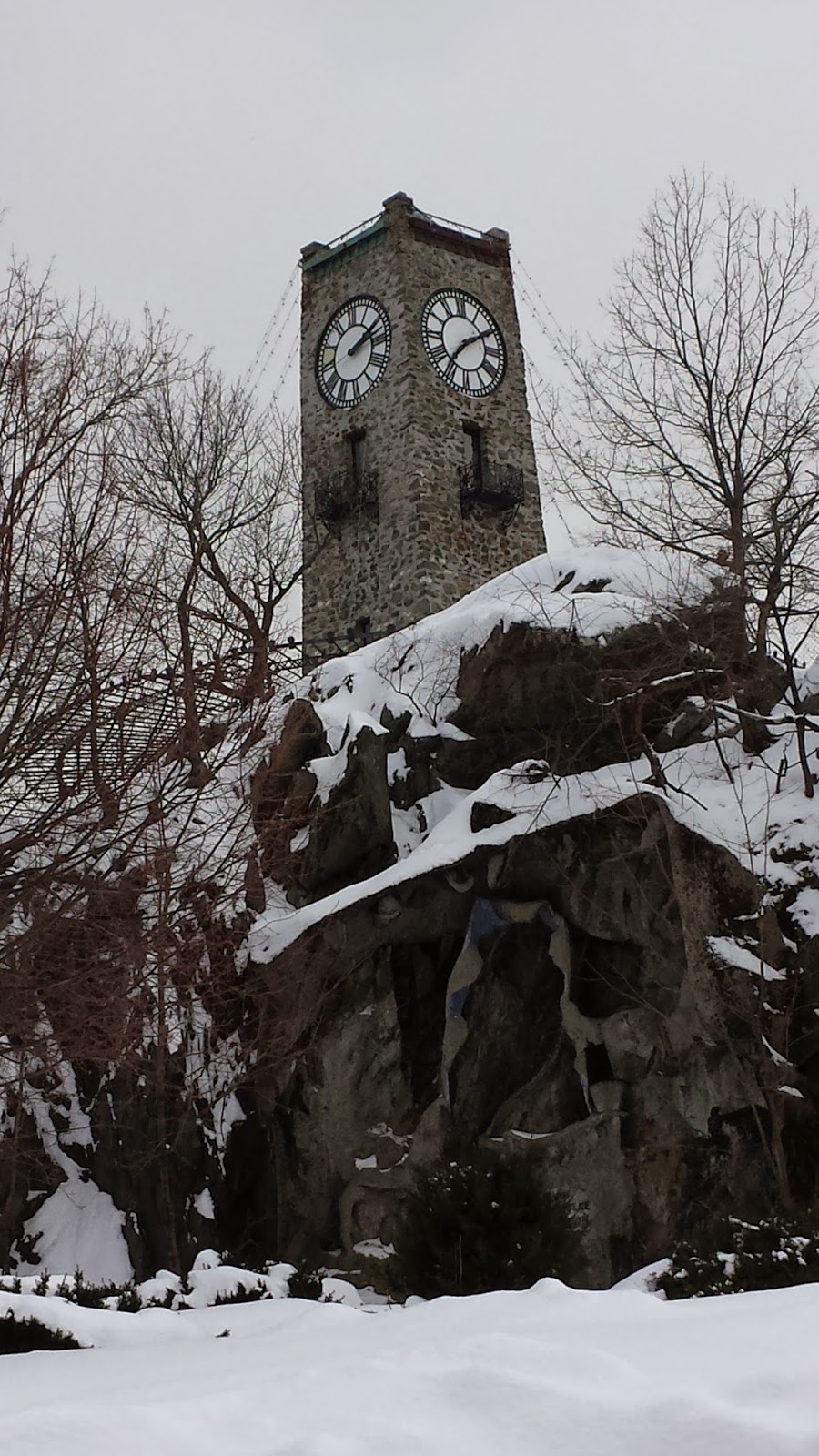
26. Becoming wealthy during the Gold Rush of 1849, she remembered her home town and donated $50,000 to build the most recognizable feature of the city. Everyone knows who she is and can see her donation....time after time. Caroline Cogswell/Cogswell Tower


It goes without saying that completing this scavenger hunt would have been a much more appealing venture if the weather was better. The snow made driving around the city really difficult, especially because people were still parking on the street. Driving around the city, I did notice that there were a lot of people just out and about, despite the bad weather. It was vacation week so there was no school. When I went to the library, there were a few kids hanging out on the steps but when I went inside it was practically empty. Admittedly, I felt sort of awkward walking and driving around the city, trying to take pictures. I felt like I stood out like a sore, white thumb. I got a few weird looks from passersby, like, who's this white girl and why is she taking a picture of my post office? I'm sure if I spent more time in the community I wouldn't feel so alien. But hey, feeling like a racial minority is something I rarely experience, so of course it felt slightly uncomfortable. I wouldn't say I felt hostility from the people I encountered, I just think it was very obvious that I was not a local.

I did enjoy researching the town of Central Falls, the most densely populated township in Rhode Island. The most interesting thing I learned about the city is that it served as a place of significance during King Phillip's War, during which 9 colonists were killed and tortured by the Naragansett's in the aftermath of an ambush. There were still a lot of questions that I could not succinctly answer, the most pressing of which to me is why there is such a large Hispanic presence in the city. I know that during the Industrial Revolution many Irish and German immigrants came to the city- do they still have a viable presence?

The biggest thing I will be taking away from this experience is the importance of knowing and understanding the community you serve. Knowing the cultural background of your students is certainly important, but there is also something to be said about literally knowing the physical landscape in which they spend their lives outside of school. For example, forging a strong tie with the public library could be very useful for providing students with an extra pillar in their support system, especially if their's is sort of lacking.
Tuesday, February 17, 2015

Mrs. McClatchy / US History: Welcome!


Name:

Welcome to our US History class! Exercise your First Amendment Rights and express yourself below. Your responses will greatly help me plan how to best run our class and how to help you as a learner. Everything you write is confidential.
 

What technology do you have access to, and where do you access it? (smart phone/computer/Internet access, etc.)


What does your typical week look like outside of school? Include your at home responsibilities, leisure activities, and afterschool commitments.


What is your first language? What, if any, other languages do you speak?


How can I help you succeed in History this year?


Describe the project from last year’s History class that you learned the most by completing. Why do you think this particular project was so enriching?


Do you believe that America is “exceptional”? Why or why not?


Understanding by Design Ch.1 / Modules A + F

I am very much on board with the idea of backwards design and focusing more on essential questions and reaching true understanding. It makes a lot of sense to me that if you want students to get to point X (true understanding/authentic performance) then you need to work backwards to the steps/skills students will need in order to reach your desired goal. It's like in the literacy that I wrote about- you don't just hope that students understand how to sail a strategic race (authentic performance/applicable to other sailing scenarios), but you need to teach them how to get their first- how to have a good start, how to determine which side of the course is favored, and even further back, how to, in a very basic sense, get their boat moving fast.

The notion of an authentic performance/task and an essential understanding seems to me one of the most important goals of education- who cares if you can recall the order of the 1st ten presidents if you can't explain how the American system of checks and balances is prone to an evolving expansion of executive power? After all, after school ends each day there is a whole other world out there; after a student graduates from high school or college, they need to enter the work force. For the critics who would say that the primary goal of education is to prepare students for a job, I would argue that UbD does just that. It gears the educational process towards a goal of skill building and growing thought, things that can be applied to other, non-academic situations.

I think that this aspect of UbD, the goal of performance and skill application ties in very well with the critics of textbook over-reliance. The authors in all three of our readings warned against relying solely on the textbook as curriculum, resource, and assessment tool (a holy trinity for lazy teachers?) but instead urge teachers to supplement their class materials with an array of sources. I think that using other sources besides the textbook will naturally lead the teacher to shift from focusing on content-acquisition to skill-building. I see this in my experience with the middle school girl, Eowyn, that I tutor a few times a week. Her Social Studies teacher does the usual "read this section, answer these questions, our test will be comprised of the content you've read- know who these people are and what happened, but don't worry, if you can memorize things you'll be golden- and if you can't, if maybe you have executive functioning weaknesses or maybe because you act developmentally like a middle schooler, well, you're kind of screwed because I'm just going to tell your parents that you aren't "applying yourself" enough, that you aren't trying hard enough." Nothing about Eowyn's Social Studies class or assignments are appealing or engineered to get her to think about American history as one experience of many that can be analyzed in terms of big themes. And I'm kind of in a difficult spot too- her father pays be to tutor her with the expectation that her grades come up. I know that her teacher is only assessing her on the basic levels of Bloom's- recall/explain/comprehend... do I use the little time we have together to try to teach her to think in the ways that UbD would applaud? Honestly, no, I don't. Because I feel like at her age it is more important that I do the job I've been asked to do, to help her grades come up. She's becoming more and more confident as an academic and a person as I've taught her tips and tricks to study well enough to ace such a basic test. To me it's more important the the relationship between her and her father improves (as the grades go up) and that she starts to think of her self as "smart" (because she gets a good grade). This whole thing may seem insanely cynical and antithetical to all we've been taught here, but I feel like I am just being extremely pragmatic.


Anyways, to shift gears, something that I haven't worked out, however, is the challenge os assessment and grading. This isn't exactly a mental hurdle just about UbD, but a quote in the text brought my issues to the surface. In What is Backward Design? the authors explain that, "because understanding develops as a result of ongoing inquiry and rethinking, the assessment of understanding should be thought of in terms of a collection of evidence over time instead of an event- a single moment-in-time test at the end of instruction- as so often happens in current practice" (13) On my copy of the reading I wrote collection of evidence vs. test @ end  }  what's a grade? growth vs. production. This was a line of thinking that had been sparked by our discussion in last week's class- that we have to give out grades, that we, ultimately, are expected to determine the value of a student's performance in a numeral. But then, after reading this chapter, I'm thinking now that if one of the big ideas of UbD is to get students to think critically and to develop better skills of expression, couldn't you argue that it may be acceptable to grade students based on their growth? Especially at the middle school age, when students are developmentally on the fence of concrete and abstract thinking, playing it safe and taking risks, and when each of your students will be at a different place on that developmental scale, couldn't it make a lot of sense to grade them on their overall growth?  Not sure yet how to continue to justify this, but I'm starting to think I'm onto something.

Monday, February 9, 2015

Harvey "Smokey" Daniels and Steven Zemelman - Chapters 1 and 2

The two anecdotes at the beginning of chapter 1 highlight the difference between reading for reading's sake, because it's what you "should do in school," and reading for the sake of engagement and building skills. A few things really struck me about the example about the fast food unit. As someone who hopes to work in a middle school, looking forward to the "team"/inter-disciplinary element, I was impressed by the interdisciplinary-ness of the unit. I believe that students learn best when what they are being taught in one class can be carried over into the next one- I think that's how learning even works in our daily general lives. If it is actually important, if you "actually need to know this/will use it," then it will become apparent in more than just one 50 minute window of your day. The diversity of reading materials in the fast food unit was also a great strength- going beyond a textbook resonates with students on a few different levels. First, I think it sends a message to students that, "hey, you guys are going to be adults some day. Let's see how you handle magazines, newspapers, etc., because we believe you are mature enough and have the skill set to handle it." In this context I believe that students are perked up when assigned something outside of a text book- it's different, special, and I believe that students probably put more effort into it. It also shows students that you, the teacher, took the time to find something truly special and out of the box(textbook) for them to read, demonstrating your care for their education. Further, the design of the reading, moving from picture book front-loading to complicated political opinion piece demonstrates the type of scaffolding that Daniels and Zemelman advocate for. Lastly, and perhaps most importantly, I thought that allowing the students great freedom in producing their final project was exceptional. Perhaps giving students a fairly free range wouldn't work if all they've been given is a text book- how can they be expected to be creative when you, the teacher, haven't been? It seems like if a unit is carefully constructed to reflect creativity and diversity in reading material that some of the creative brainstorming has already been done for students, showing them how to think outside the box(textbook). The students in the fast food unit anecdote were clearly invested in their learning- they really cared about the experience- because they were allowed to feel like they had an element of control over the process, as opposed to being told "Read chapter 2 for Friday. Quiz to follow."

In chapter 2, "How Smart Readers Think," Daniels and Zemelman demystify the science of reading, breaking down a seemingly "split-second-don't-even-think-about-it" process into a visible skill of many parts. After reading this chapter, I reflected on my own education and I came to realize that I, too, had been barely taught "how to read" after elementary school. I definitely had teachers who did not view themselves as teachers of literacy. As a teacher candidate aiming to teach the Social Sciences, helping my future students master various reading strategies and skills is especially imperative. It will be important that I, as Daniels and Zemelman say, "teach reading, not just assign it" (41). I think that the process of doing so reflects the teaching style advocated by Wilhelm- the I do/we do/you do model. I imagine this process would include group reading, graphic organizers, short reflections, etc. all which would help guide the students towards being able to internalize the types of close reading strategies that will help them succeed not just in my class but in all their classes and, hopefully, their daily lives.